Sole trader or limited company? Single entity or holding structure? The decisions you make in week one will still be with you in year five - and some are a lot harder to unwind than you think.

5min read
The Default Is Not Your Friend
When you start making money as a founder, the path of least resistance is to keep things simple: sole trader, or a quick limited company incorporated in an afternoon. Both feel fine at the start. Neither is necessarily wrong. But structure is not just a formality - it is your first line of legal defence.
A company is, in legal terms, a separate entity from you as an individual. That matters enormously. If your business runs into trouble - a client dispute, a contractual claim, a debt you cannot service - your personal assets are protected. Your home, your savings, your life outside the business stays intact. That protection disappears the moment you have operated negligently or fraudulently, but for the vast majority of founders navigating honest commercial risk, the limited company structure is the right call.
The filing requirements are real but manageable: annual accounts, a confirmation statement, and updates to Companies House when your share structure or directors change. The admin overhead is small relative to the protection you get.
The Dual Company Structure: When One Company Is Not Enough
Here is where it gets interesting - and where most founders stop short.
If your startup has valuable intellectual property, significant cash reserves, or you are planning to run more than one business under the same ownership, a dual company structure is worth serious consideration.
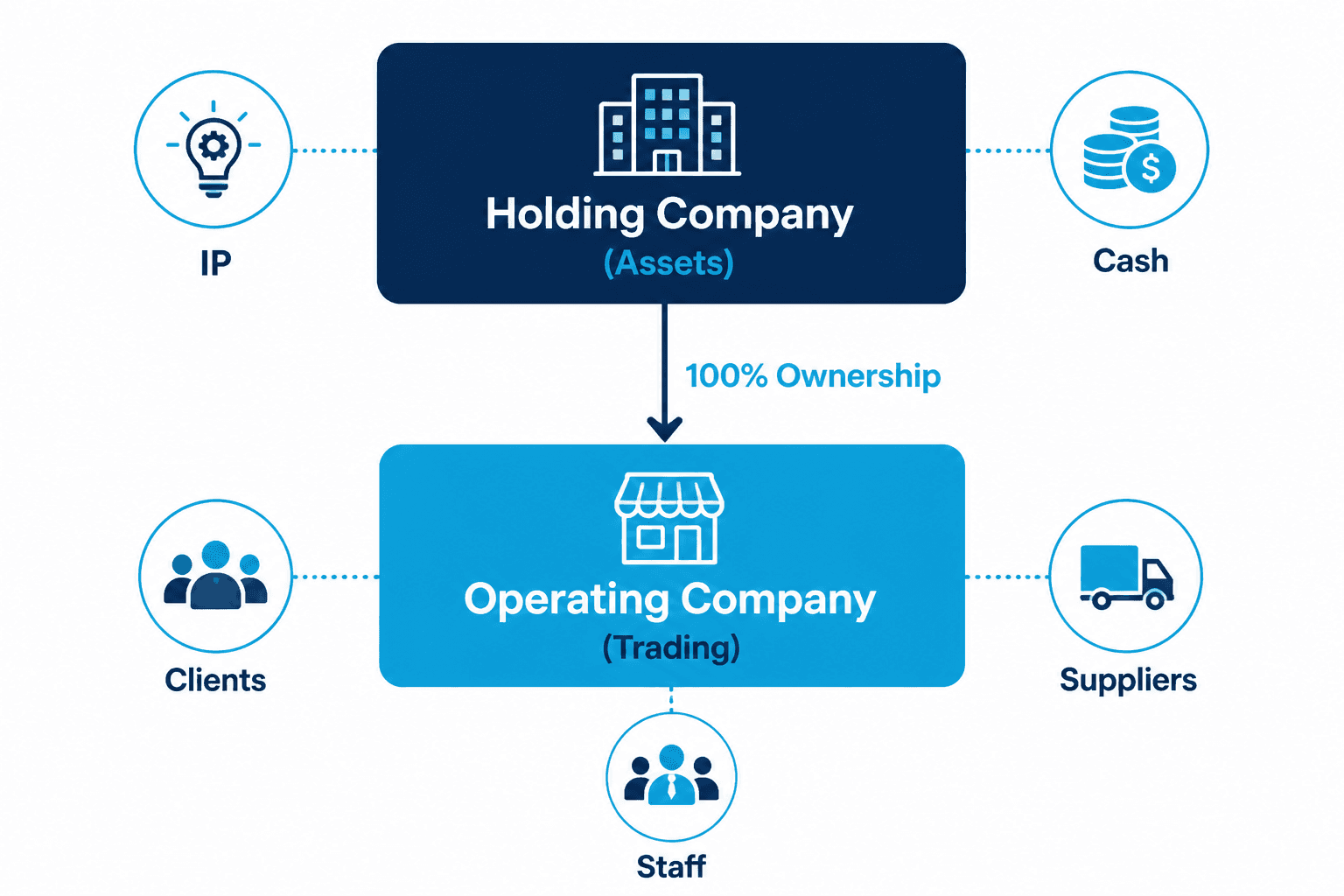
The model works like this: a holding company sits at the top and owns 100% of the shares in an operating company. The operating company is the entity that signs contracts with clients, employs staff, and deals with suppliers day to day. The holding company holds the valuable assets - primarily IP and cash reserves.
Why does this matter? Because liability follows the contract. If a client sues, they sue the entity they have a legal relationship with: the operating company. The holding company, and its assets, sits a layer above that exposure. Your most valuable assets - the IP you have spent years building, the capital you have carefully raised - are insulated from operational risk.
The same logic applies if you are running parallel ventures. Two operating companies under one holding company means that if one business line runs into problems, the other is not dragged down with it.
What This Looks Like in Practice
A founder building a SaaS product alongside a consulting practice might structure it with a holding company owning two separate operating entities: one for the software business, one for the services business. Clients, revenue, and risk stay separate. IP and cash flow up to the holding company.
There are costs to this approach. Incorporating and maintaining an additional company takes time and money. In certain narrow circumstances - fraud, improper conduct, or a finding that the companies are not under separate management - a holding company can be held responsible for its operating subsidiary's actions. These are edge cases, but they are worth understanding.
The decision comes down to a simple question: what do you have that is worth protecting? If the honest answer is "not much yet," a single well-structured company may be all you need for now. If you are sitting on IP that represents real future value, or you are building for multiple revenue streams, the dual structure is worth the investment.
The Move Most Founders Miss
IP assignment is the quiet failure point in early-stage startups. You built the product before the company was properly incorporated. A contractor developed the core code. A co-founder designed the brand. None of it was formally assigned to the company.
Then you try to raise capital - and an investor's legal team starts asking questions. Who actually owns this IP? Can you prove it? The answer, in too many early-stage due diligence processes, is "not as clearly as we thought."
An IP assignment agreement is not glamorous. But it is the document that closes the gap between what you built and what your company actually owns.
Get the Foundation Right Before You Build on It
Structure is not the most exciting part of building a company. But getting it wrong is expensive - not just financially, but in the time it takes to unwind and rebuild what should have been set up correctly from the start.
Founder.Careers has partnered with LegalVision, a commercial law firm specialising in UK startups, to give our community access to the legal guidance that matters most at each stage of growth. If you want to stress-test your current structure - or build the right one from scratch - a free legal health check is a good place to start.